
Uncategorized
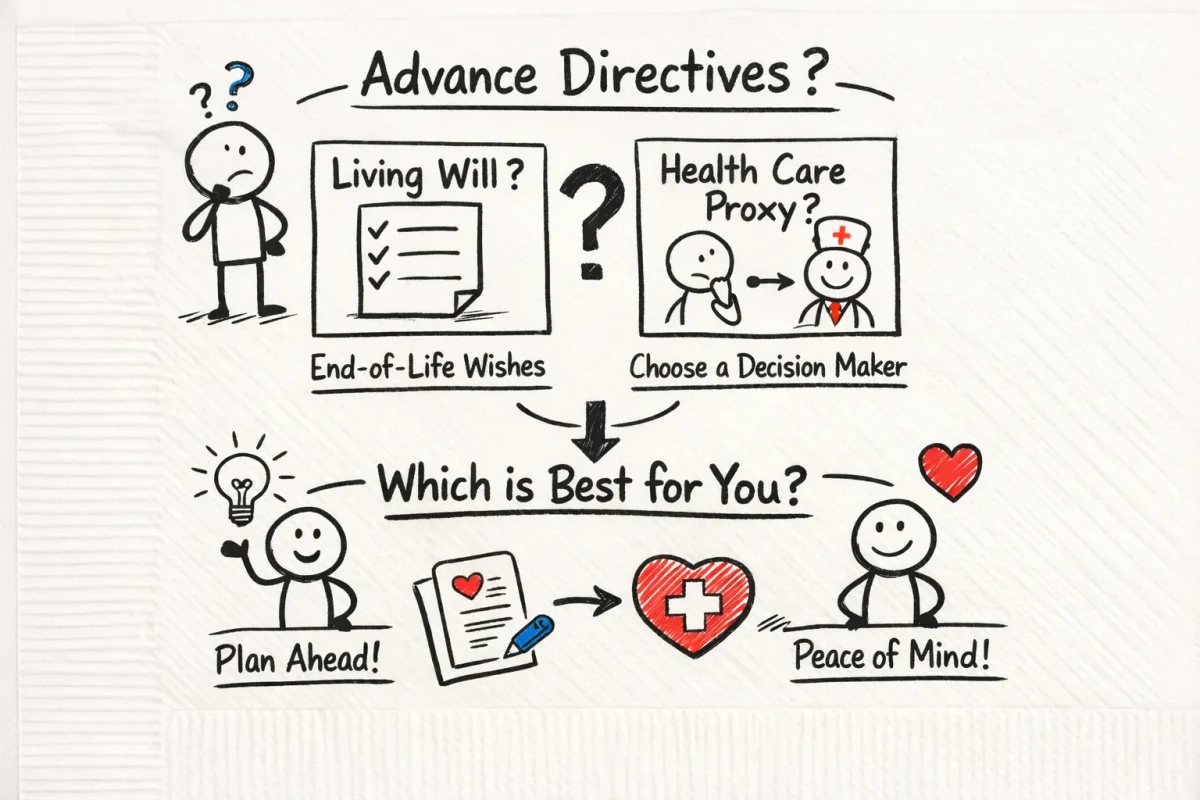
Advance Directives Reviewed: Which Type Is Right Today?
Feb
Introduction
Planning your healthcare decisions in advance is not a theoretical exercise; it is a practical kindness you give to yourself and the people who will carry your wishes forward. Talking about what might happen if you cannot speak for yourself is heavy—but it becomes lighter when the conversations are precise, the documents clear, and the logistics understood.
At EUTHAEND we pair clinical rigor with discreet, compassionate support—if you want expert review of your documents, we’ll walk with you. This article is written to help you compare the principal advance-healthcare documents used in the United States—what each covers, how they work in real medical settings, typical costs and timeframes, and which combinations make sense for common situations. Think of it as a product-review for your future care: practical, specific, and framed around dignity and autonomy.
Quick verdict — at-a-glance recommendations and top picks
Here are the simple, action-oriented recommendations you can use right away. If you only do one thing today, appoint a trusted medical agent and document it. From there, add a written statement of your treatment preferences. When serious illness is already present, translate those preferences into clinician-signed orders.
Top picks, one-liners:
- Best single-document starter: Living will paired with a medical power of attorney (POA) — broad coverage and practical.
- Best for someone with serious, progressive illness: POLST/MOLST plus medical POA — immediate clinician orders plus an agent.
- Best for psychiatric crises: Psychiatric advance directive (PAD) with a psychiatric agent and clear crisis plan.
- Narrow but critical: DNR/DNI orders — essential when your priority is to avoid resuscitation in a cardiac or respiratory arrest.
The table below gives a compact, fast-read comparison of the main instruments, their scope, typical cost band, relative portability, and a summary star rating based on our rubric.
| Instrument | One-line scope | Typical cost band | Portability | Summary rating |
|---|---|---|---|---|
| Living will | Written instructions about life-sustaining treatment in defined end-of-life conditions. | $0–$1,500 (free templates to attorney) | Moderate (hospital-recognized; EMS limits) | ★★★★☆ (4.2/5) |
| Medical POA / Healthcare proxy | Designates a person to make healthcare decisions when you cannot. | $0–$1,500 | High (agent acts across settings) | ★★★★★ (4.6/5) |
| POLST / MOLST | Clinician-signed medical orders translating current preferences into actions. | Clinician time only; no filing fee | High within-state; variable across states | ★★★★☆ (4.4/5) |
| DNR / DNI | Clinician order to withhold CPR and/or intubation in arrest. | Clinician time; often no fee | Variable; must be physician-signed for EMS | ★★★★☆ (4.0/5) |
| Psychiatric advance directive (PAD) | Specifies mental-health treatment preferences and names a mental-health agent. | $0–$1,000+ | Moderate (state law dependent) | ★★★★☆ (4.1/5) |
When to call for help: for document review, secure storage, and clinician coordination—EUTHAEND can provide confidential consultations and help ensure forms are clear and accessible in a crisis. For complex estate planning, guardianship questions, or contentious legal situations, consult an attorney experienced in health law and elder law. When you need clinician-signed medical orders (POLST, DNR), coordinate with your treating clinician or a hospital palliative-care team; EUTHAEND can help facilitate those conversations and ensure documentation is correctly executed and stored.
Our review method — criteria, legal lens, and compassionate standards
We treated each document type like a product and applied a consistent rubric to judge usefulness in real-world practice. This rubric weights legal force most heavily while honoring the ethical and emotional realities people face when planning.
Review rubric (weighted): legal force and enforceability 30%; clarity and specificity 20%; portability and immediacy 20%; ease of creation 15%; cost and access 15%. These factors reflect what clinicians, EMS, and families actually need when decisions must be made quickly and decisively.
Sources checked include state statutes and templates, hospital and EMS policies, POLST program guidance, palliative-care resources, and mental-health statute summaries. We flagged wide state-by-state variation where it exists—especially for POLST reciprocity, PAD recognition, and the specifics of witnessing or notarization. For clinical and legal context we reviewed authoritative summaries such as the professional overview of advance directives, and consulted peer-reviewed analyses of advance-care-planning impacts to inform our recommendations.
Tone and ethics: this is informational, not legal advice. Our intent is practical clarity. If a situation is complex—interstate moves, guardianship disputes, or unusual incapacity questions—seek local counsel. Wherever possible, choose state-approved forms and document conversations with your agent and clinicians in writing.
Living wills — what they do, how they perform, and when to use one
A living will is a written statement of your treatment preferences to guide clinicians if you are no longer able to communicate and meet the medical criteria set by law (for example, terminal illness or permanent unconsciousness). It lets you express specific approvals or refusals for life-sustaining interventions: CPR, mechanical ventilation, artificial nutrition and hydration, dialysis, antibiotics, chemotherapy, and preferences for comfort-focused care.
Activation and enforceability depend on clinical triggers. Most living wills take effect when you lack capacity and a qualified clinician determines that you meet the condition specified in your form—commonly terminal illness, end-stage disease, or persistent vegetative state. Hospitals generally honor living wills in charted decisions, but in a sudden out-of-hospital arrest EMS personnel typically require a physician-signed DNR or POLST to withhold resuscitation.
In practice the living will’s strengths are clarity and permanence: a written statement reduces guesswork for clinicians and gives family members a document to reference during emotionally fraught conversations. Its core weakness is scope: it describes how you want to be treated in certain states of health but does not appoint who will interpret nuance when situations are unforeseen. Vague language—words like “extraordinary measures” or “life-prolonging treatment” without definition—invites delay and dispute.
Ease of creation and costs vary. Most states and many hospitals provide free forms you can complete in 15–60 minutes. Online guided tools add convenience for modest fees ($0–$100), while attorney-assisted drafting offers customization and legal review ($500–$1,500 or more). For most people a state-approved template, carefully filled and witnessed or notarized according to state rules, is sufficient and practical.
Portability: living wills are widely recognized by hospitals and long-term care facilities within the state where they were executed, but they are not a substitute for a physician order if you need EMS to withhold resuscitation outside a hospital. If you split time between states, consider completing directives in each jurisdiction where you spend significant time.
Drafting tips that make living wills useful in the real world: name the clinical conditions that activate your directions; avoid vague catch-phrases; be specific about ventilation, feeding tubes, dialysis, and antibiotics; explicitly allow comfort-focused palliative care regardless of other refusals; and date and sign the document. A short paragraph explaining your values—the goals that underlie choices—helps an agent or clinician interpret ambiguous situations.
Real-world vignette: Maria, age 72, with metastatic lung cancer, specifies in her living will that she does not want prolonged mechanical ventilation if her disease has become refractory, but she does want full comfort care and short-term antibiotics for treatable infections if they will relieve suffering. When her breathing worsened suddenly, the living will clarified intent while her medical proxy negotiated a short trial of noninvasive support to assess reversibility.
Pros: living wills are inexpensive, widely accepted in hospitals, and allow patients to state preferences directly. Cons: they do not name a decision-maker and may not be actionable in a sudden emergency without a clinician order. For people who want explicit written treatment limits, a living will is essential.
EUTHAEND note: we review living-will language for clarity and state compliance, suggest phrasing that avoids ambiguity, and can provide secure, confidential storage so clinicians and agents can access documents quickly when needed. Learn more about our review standards in our Quality Assurance, EUTHAEND documentation.
Rating & verdict: 4.2/5. Prioritize a living will if you want explicit written limits on life-sustaining treatments, and pair it with a medical POA so someone can interpret and implement those wishes.
Medical Power of Attorney / Healthcare Proxy — who can speak for you
A medical power of attorney (also known as a durable power of attorney for healthcare or healthcare proxy in some states) appoints a trusted person to make healthcare decisions for you when you lack capacity. This instrument is the single most practical tool for unpredictable medical events because it centralizes decision-making authority in a known, reachable individual.
Scope is typically broad: an agent can access medical records, speak with clinicians, accept or refuse treatments, and make day-to-day and emergency decisions consistent with your known wishes and values. Many forms allow immediate effect (for administrative reasons) but usually specify that the agent’s authority is triggered when you lose capacity. You can name alternates, limit authority in specific areas, or require the agent to follow particular instructions outlined in an accompanying living will.
In practice the POA’s strength is flexibility. When a new, unforeseen clinical dilemma arises—one your living will did not anticipate—the agent can act quickly. The primary risk lies in poor agent selection: choose someone who understands your values, can tolerate stress, communicates clearly, and is available when needed. Agents sometimes disagree with family members or are challenged in court if they act contrary to documented wishes, so it helps to document conversations and have the agent confirm understanding in writing.
Ease and cost mirror living wills: state templates are usually free; online tools are inexpensive; attorneys can customize language and provide guardianship avoidance clauses. Choosing and preparing your agent is the time investment that matters most. Talk through scenarios, give them access to your medical information, and provide a short, dated values statement so they can point to your reasons if decisions are contested.
Best practices in choosing an agent include prioritizing trust over proximity when values and emotional steadiness matter; naming an alternate; explicitly granting access to medical records; and including guidance on life-sustaining treatments and palliative preferences. Many people add a clause authorizing the agent to seek second opinions or consult palliative care specialists.
Vignette: After a sudden stroke, James lacked capacity. His medical POA—his sister—had discussed his wishes in detail and presented a short values letter to the treating team. That clarity shortened deliberations and kept the focus on treatments consistent with James’s priorities.
Pros: POAs are flexible, broadly applicable, and reduce family conflict when the agent is prepared. Cons: a poorly chosen agent can misinterpret your wishes or be unavailable; POAs can be contested in complex cases.
EUTHAEND note: our confidential consultations can help you choose and prepare an agent, draft clear instructions, and manage notarization or witnessing requirements as your state requires. We can also coordinate secure distribution of your documents so the right clinicians and family members have timely access.
Rating & verdict: 4.6/5. For almost everyone, a medical POA is the highest-priority document; pair it with a living will for the clearest protection and guidance.
POLST / MOLST — when clinician orders matter most
POLST (Physician Orders for Life-Sustaining Treatment) or MOLST in some states is a clinician-signed medical order set that converts a seriously ill person’s treatment preferences into actionable orders. Unlike living wills, POLST is a medical order: it is written by a clinician, signed by the clinician (and the patient or surrogate), and intended to guide current medical care across settings.
Typical sections include instructions about CPR (full code vs DNR), the overall scope of interventions (comfort-only, limited interventions, or full treatment), preferences about antibiotics and artificial nutrition, and sometimes preferred hospitalization settings. POLST forms are usually distinctive—often colored—and are designed to be kept visible in the home and carried between care settings.
Enforceability is high within a state’s healthcare system: hospitals, nursing homes, and many EMS agencies will follow POLST as a medical order. Its intended audience is seriously ill patients whose likely near-term clinical decisions merit a standing medical order. POLST is not meant for generally healthy people as a substitute for a living will or POA.
Strengths: POLST provides immediacy and clarity—clinicians can act on these orders without delay. Weaknesses: variation across state forms can create confusion if you move or travel; POLST does not replace an advance directive or a POA for broader decisions. Because POLST is clinician-dependent, it requires a clinical conversation and signature; that conversation is a valuable forcing function to ensure preferences are translated into practice.
Cost and ease: there is usually no public filing fee, but clinician time is required. POLST forms are typically completed in clinic or hospital settings, often with palliative-care teams. When you have a progressive disease and want orders that will be followed now, arranging a POLST with your clinician is the correct path.
Practical workflow advice: get the clinician signature, keep the original in the home, provide copies to caregivers, upload to electronic health records where possible, and re-evaluate the form after major health changes. If you cross state lines frequently, check the receiving state’s POLST program; many states will consider out-of-state forms but do not guarantee identical legal force.
Vignette: A patient with advanced heart failure and frequent hospitalizations completed a POLST specifying “Do Not Intubate; limited interventions; full comfort care.” EMS and hospital teams followed those orders during a crisis, avoiding invasive escalation inconsistent with the patient’s goals.
EUTHAEND note: we assist clients in preparing for the clinician conversation, clarifying language to avoid ambiguity, and coordinating follow-up so the POLST reflects both clinical reality and personal values—while keeping the process confidential and traceable.
Rating & verdict: 4.4/5. POLST is powerful when serious illness is present and you need standing medical orders; it should always be paired with a POA and living will for full coverage.
DNR / DNI orders — narrow scope, meaningful impact
DNR (Do Not Resuscitate) and DNI (Do Not Intubate) are clinician orders that instruct medical personnel not to perform CPR and/or endotracheal intubation if cardiac or respiratory arrest occurs. Their scope is deliberately narrow: they address the event of arrest, not the broader spectrum of life-sustaining care before arrest.
How DNRs differ from living wills and POLST is important: a living will expresses preferences across an end-of-life trajectory; POLST translates current goals into orders for multiple interventions; a DNR addresses the one emergency intervention of resuscitation or intubation. For out-of-hospital scenarios, EMS typically requires a specific, physician-signed DNR form or state-recognized bracelet/registry entry to withhold CPR.
Enforceability: in hospital settings, a DNR entered in the chart is honored. Outside hospitals, the legal recognition of DNR depends on state rules and the presence of the required documentation. A DNR does not imply refusal of other treatments such as antibiotics, IV fluids, or hospitalization; without accompanying documents or a clear medical order set, staff may continue other treatments consistent with goals of care.
Practical limitations include confusion among family members who may assume “no DNR” equals “no treatment.” Clear communication is essential: explain that DNR pertains solely to CPR or intubation unless combined with other directives. Some states provide recognizable forms or registries—check local rules and ensure EMS has access to the form if you want your DNR to apply outside the hospital.
Vignette: An older adult with progressive pulmonary disease chose a DNR but requested full comfort care for exacerbations. The DNR was documented in the chart, and the patient carried a clinician-signed copy at home so EMS and home health could see the order.
Pros: DNR orders avoid unwanted resuscitation in arrest and are clear when properly documented. Cons: narrow scope may cause misunderstanding; must be visible to EMS to have out-of-hospital effect. Combine DNR with living will and POA to avoid misinterpretation.
Rating & verdict: 4.0/5. Essential when resuscitation would be inconsistent with your goals; secure a clinician-signed order and make it accessible to EMS and caregivers.
Psychiatric advance directives — planning for mental-health crises
A psychiatric advance directive (PAD) is a targeted tool that allows a person with mental-health conditions to state treatment preferences for future behavioral-health crises and to appoint a proxy for psychiatric decisions. PADs typically include specific medication preferences or refusals, preferred hospitals or clinicians, de-escalation strategies, and contact information for supportive services.
Activation and enforceability vary across states. Many states explicitly recognize PADs; others allow general advance directives to cover psychiatric care to some degree. PADs usually activate when the person is determined to lack capacity during a psychiatric crisis, though the exact legal trigger and whether providers must comply differ by jurisdiction. Emergency holds or criminal-law exceptions can override PADs in situations where there is imminent danger to self or others.
In practice PADs empower people with serious psychiatric illness to preserve elements of autonomy that are often lost during crises. They can reduce coercive interventions when respected and improve outcomes by making preferences known in advance. The primary limitation is variability in provider acceptance and statutory rules. Some clinicians may be uncertain how to honor PADs during legal holds or involuntary treatment; in those situations, a PAD can still guide less coercive options and help align care with the person’s values to the extent allowed.
Drafting nuances that increase utility: include clear behavioral triggers that indicate crisis, list medications to avoid with clinical rationale, name preferred and non-preferred hospitals, spell out preferred de-escalation and outpatient supports, and appoint a psychiatric agent who understands crisis plans. Attach copies of recent medication trials and side-effect histories to help clinicians act quickly.
Costs and ease: many PAD templates are free or inexpensive; complex guardianship or involuntary-treatment concerns may justify attorney involvement. PADs benefit from clinician buy-in—share the document with your psychiatrist and local crisis teams and ask them to incorporate it into your chart where possible. Consult state PAD resources such as the National Resource Center on PADs for state-specific templates and instructions.
Vignette: Sam, who has bipolar disorder, documented a PAD refusing a specific class of antipsychotics after a severe prior adverse reaction while appointing a trusted friend as psychiatric agent. During a crisis, the PAD helped staff avoid the medication Sam feared and instead use a tolerated alternative while maintaining safety.
Pros: PADs preserve autonomy and reduce coercion when respected. Cons: legal recognition and enforcement vary; emergency exceptions can override preferences. Advocate for PAD recognition with your clinicians and legal advisers.
EUTHAEND note: we help clients link PADs to local crisis resources, coordinate clinician review, and provide confidential storage so crisis teams can access directives quickly when time matters.
Rating & verdict: 4.1/5. Highly valuable for people with known psychiatric conditions—ensure clinicians and crisis teams are aware and that the PAD complies with state rules.
Side-by-side comparison — scope, activation, portability, and practical bundles
Each instrument has a clear purpose and ideal use-case. Understanding the differences lets you assemble a package that covers both predictable and unpredictable scenarios.
Concise comparison by function: living wills record your treatment instructions for defined end-of-life conditions; medical POA names a surrogate to make broad healthcare decisions; POLST turns current goals into clinician orders for immediate use; DNR is a narrow clinician order for arrest situations; PADs specify psychiatric treatment preferences and a mental-health proxy. Who signs varies: living wills and POAs are patient-written and signed (with witness/notary rules); POLST and DNR are clinician-signed orders; PADs may require specific formalities depending on the state.
Recommended bundles for common situations:
- Terminal or seriously ill patient: POLST + medical POA + living will. POLST provides immediate orders; POA speaks for you in nuanced cases; living will documents broader values.
- Early dementia diagnosis: medical POA + living will now; revisit for POLST as disease progresses and goals become more immediate.
- Advance planner without current illness: living will + medical POA, with a reminder to review every 2–5 years or after major health changes.
- Severe psychiatric illness: PAD + medical POA (consider a separate psychiatric agent) + strong care-team communication plan.
Decision flow—short form: if you need immediate clinician orders because serious illness is present, choose POLST; if you want a trusted person to act for you in unpredictable events, appoint a medical POA; if you want to document limits on life-prolonging measures in defined end-state conditions, draft a living will; if your priority is to avoid resuscitation in an arrest, obtain a DNR clinician order; if your concern centers on psychiatric crises, use a PAD.
Mixing documents improves coverage but watch for contradictions. Precedence generally runs: a competent patient’s current wishes override any other document; explicit contemporaneous clinical orders (POLST/DNR) are followed by clinicians as medical orders; a medical POA should follow the patient’s known wishes and any applicable advance directives. To avoid disputes, ensure documents are mutually consistent and that your agent understands how you expect them to interpret conflicts.
How to create, sign, store and share your directives — a practical how-to checklist
The following ordered checklist describes the most reliable sequence for creating and activating advance-care documents. Follow the steps to maximize enforceability and reduce friction when decisions are needed.
- Clarify goals: write a short values statement (2–4 sentences) that explains what quality of life means to you and what outcomes you want to avoid. Use concrete examples—e.g., “I do not want long-term mechanical ventilation with no reasonable chance of recovery.”
- Choose documents: select a medical POA and a living will as baseline; add POLST or DNR if you or your clinician anticipates near-term treatment decisions; add a PAD if you have a diagnosed psychiatric disorder with prior crises.
- Select forms: use your state’s official templates where available or hospital-provided POLST forms for clinician orders. For PADs, consult state PAD guidance or the National Resource Center on PADs for templates and instructions. For a quick reference to state-specific advance directive forms, see a consolidated state-by-state advance directive forms guide.
- Draft clearly: avoid vague terms. Specify triggers, define “permanent” or “terminal” where possible, and include a palliative care clause permitting comfort-focused treatment regardless of other refusals.
- Sign correctly: follow state witness/notary rules precisely—some states require two witnesses, others accept notarization. If in California, for example, use two qualified adult witnesses or a notary; in some states a notary can substitute for witnesses.
- Obtain clinician orders where needed: schedule a clinician conversation for POLST or a physician-signed DNR; request that the order is placed in your chart and that you receive a signed copy for home use.
- Distribute copies: provide copies to your agent, alternate agents, primary care clinician, specialists, and hospital medical records. Keep an original or certified copy in a known, secure place at home and carry a wallet card noting your agent and living-will location. For physical delivery and handling of documents, consult our Shipping Policy, EUTHAEND.
- Register and upload: where state registries exist, register your advance directive; upload copies to patient portals (MyChart) and use secure cloud storage for quick access. Ensure passwords and access instructions are given to your agent where appropriate.
- Review and update: revisit documents after major life events (diagnosis, move to another state, new relationships) or every 2–5 years. Initial and date any amendments, and remove or clearly mark superseded versions.
- Document conversations: write a brief note after important conversations with your agent or clinicians and attach it to your directives. Having contemporaneous notes reduces later disputes about intent.
Witness and notary quick guide: most states require two adult witnesses who are not your named agent, not related by blood or marriage, and not entitled to your estate. Some states permit a notary public in place of witnesses; a few require both witnesses and notarization. California’s Advance Health Care Directive, for example, is valid with two qualified adult witnesses or a notary. Always check your state-specific form instructions before signing.
Emergency access and portability tips: keep a hard copy of clinician-signed POLST or DNR in a prominent place at home, provide a copy to home healthcare and primary EMS contacts, and wear a medical ID only as a supplement—not as a replacement for a signed order. Digitally, upload directives to your EHR patient portal and use secure storage solutions that allow rapid, authenticated access for clinicians. EUTHAEND provides confidential storage options with chain-of-custody tracking so your documents are both private and quickly retrievable in emergencies.
Costs and timelines: free state forms and hospital templates can be completed the same day; online guided services typically generate documents within minutes to a day for modest fees; attorney-assisted drafts take days to weeks and cost $500–$2,000 depending on complexity. POLST and DNR orders commonly only require clinician time and are usually completed during clinic visits or hospital stays. Peer-reviewed studies have shown that structured advance-care-planning conversations increase completion rates and can affect care patterns, which informed our cost and impact estimates.
Common pitfalls, disputes, and how to prevent them — legal caveats and final recommendations
Disputes arise for predictable reasons: contradictory documents, ambiguous phrasing, lack of accessible documentation, agents acting outside known wishes, and interstate differences in recognition. Prevent these issues by using state-approved forms when available, writing clear triggers and definitions, naming alternates, and ensuring copies reach clinicians and EMS.
Prevention strategies that work: keep documents consistent; add a brief values statement to guide interpretation; record and date conversations with your agent and clinicians; register documents where possible and upload digital copies to patient portals; and use clinician-signed orders (POLST/DNR) when you need out-of-hospital actions respected. If you travel, consider creating directives in the states where you spend significant time or confirm reciprocity with receiving institutions.
If a dispute arises, practical triage steps include notifying the hospital ethics committee or patient advocate, asking for a palliative-care consult to clarify goals, and using rapid mediation or documented statements of intent. EUTHAEND provides mediation-style guides and confidential documentation support to help clarify intent—this is often enough to align clinical decisions with patient wishes without formal litigation.
Legal caveat: this article is informational and not legal advice. For guardianship, interstate recognition issues, or complex estate-and-health planning interactions, consult a licensed attorney with experience in elder law or health law in the relevant jurisdiction. See our Terms, EUTHAEND for service and liability details.
Starter packages (recommended document bundles):
Starter Planner Package (most adults): living will + medical POA + dated values statement + EUTHAEND document review and secure storage. This combination gives baseline legal protection and clear guidance to your agent and clinicians.
Serious-Illness Package: POLST + medical POA + living will + clinician coordination by EUTHAEND. This adds immediate clinician orders and ensures the POLST reflects your values and is properly signed and distributed.
Mental-Health Package: PAD + psychiatric agent + care-team communication plan + secure crisis-access storage with EUTHAEND. This bundle helps preserve autonomy during psychiatric emergencies and ensures crisis teams can access directives quickly.
For more general posts and updates, see our Uncategorized, EUTHAEND page.
Final practical call to action: create a medical POA and living will today—use your state’s official template, sign with the correct witnesses or notary, tell your chosen agent where the documents are stored, and consider a confidential EUTHAEND review to ensure wording is clear and that clinician coordination is in place when needed. If you would like direct assistance, please reach out via our Contact EUTHAEND, Secure Support for Peaceful Solutions.
Conclusion
Good planning is a gift you give to yourself and those who will care for you. For most people, the immediate next step is simple and high-impact: appoint and prepare a trusted medical agent and document that choice in a durable medical power of attorney. Pair that with a clear living will that expresses your values. Add POLST or DNR when illness makes clinician orders necessary, and use a PAD if psychiatric crises are a concern.
Laws and forms vary by state—verify local rules and, if your situation is complex, speak with local counsel. If you would like a confidential, compassionate review of your directives, or secure storage and clinician coordination, EUTHAEND offers discreet consultations and document services designed to protect privacy and ensure your wishes are accessible when they matter most.
